John Simpson, a revered brass instructor and arranger whose pursuit of impeccable tone and intonation transformed drum corps performance and influenced generations of musicians, died last week. He was 83.
Lifelong friend and fellow DCI Hall of Fame member Steve Vickers reported his death the morning of Friday, November 14.
Simpson, who was inducted into the DCI Hall of Fame in 2014, was introduced to the drum corps activity at an early age. After pedaling his bike to a competition near his home in Hutchinson, Kansas, he encountered the “brilliant sound of G-(keyed) bugles.” “I had heard bands before, but this was different,” he recalled in his Hall of Fame induction speech. “I was hooked at age 10.”
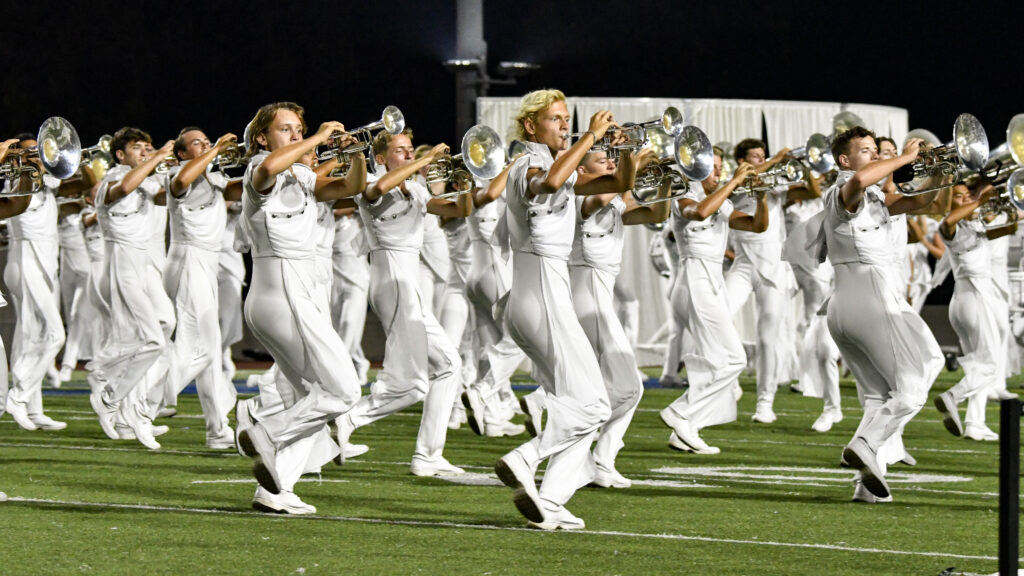
He was perhaps best known for cultivating a distinctive, vibrant sound quality in the brass sections of a number of corps, including the Sky Ryders, Bridgemen and Star of Indiana. His sections were famed for their dynamic extremes and powerful musicality, an approach former students and colleagues dubbed the “Simpson Sound.”
“His brass sections had an unmistakable vibrancy of tone and always played with good tuning,” wrote Chris Knighten, an alum of the Sky Ryders who now directs bands at the University of Arkansas, in Simpson’s Hall of Fame nomination letter. “The resulting ‘Simpson Sound’ was powerful, full of dynamic extremes and incredibly musical and entertaining.”
Simpson’s career coincided with a period of rapid development in the instruments used in the drum corps activity. In the 1960s, while performing with the United States Air Force Drum and Bugle Corps and later with the New York Skyliners, he began exploring the limits of the rudimentary, single-valved bugles of the time.
A key contribution was his collaborative work with DCI Hall of Fame member Robert “Pepe” Nataro to develop the “slip-slide” technique. This innovation incorporated valve and valve-slide combinations, allowing brass players to access a greater number of notes.
As an arranger, working with figures like DCI Hall of Fame member Larry Kerchner, Simpson capitalized on these new technical possibilities. “John helped fashion arrangements that incorporated key signatures that allowed for more chromaticism, resulting in a much richer harmonic palette than heard from most corps in that era,” Knighten said.
Simpson also held a deep respect for musicality across all sections, a philosophy exemplified by his friendship with percussion arranger and Sky Ryders director George Tuthill, a professional jazz drummer who worked with the likes of singer Edie Adams and tenor saxophonist Sonny Rollins. Simpson often lamented the era’s common approach to percussion, saying, “I had had my fill of hearing drum corps play ballads with a drum part that resembled the downfall of Paris or kinetic halftime.” In contrast, he lauded Tuthill’s work, noting, “His parts fit the music like whipped cream on pumpkin pie at Thanksgiving.” This dedication to holistic musicality ensured that Simpson’s brass lines were always supported by thoughtfully arranged accompaniments.
JD Shaw, current brass arranger for Phantom Regiment and a former member and student of Simpson with the Sky Ryders, credits him with producing some of DCI’s most technically sophisticated and audience-connecting horn lines in the late 1970s and ‘80s.
Simpson’s influence extended beyond technique and arrangement. He championed the development of new instruments, such as the King contrabass bugle utilized by the Sky Ryders and Blue Devils in the early 1980s. He also advocated for changes in the DCI adjudication system to reward corps that prioritized musicianship.
First and foremost, however, Simpson was an educator whose principles were absolute. “(John) was a true devotee to proper brass pedagogy and was immovable in his standards of excellence,” Shaw said. “To this day, as a professional performer, I regularly refer back to his tenets of sound production, listening and musical nuance.”